Architrave F (449)
Esna 449
- Location: Architrave F
- Date: Uncertain
-
Hieroglyphic Text
- Epigraphic Text
- Bibliography: Von Lieven 2000, pp. 160-163; Altmann-Wendling 2019, p. 631 (excerpts); see also Tempeltexte 2.0.
1gb.t ỉʿ.tw
nn ḥty.t ỉm=s
ỉw ḫnty-nḏm-ʿnḫ wbn(.w)
m-ḫnt=s
mỉ psḏ-m-nbw m-ḥȝ.t
nḫn m wnm.t
ḫnty-tȝ.wy-nṯr.w
m ỉwn
ḏȝỉ=f ḥr.t
nḥȝ-ḥr bṯn(.w) m wnw.t=f
nṯr.w nṯr.yt
ỉb=sn nḏm(.w)
ḥnmm.wt m sns n ḥr=f
ʿḥʿ ḫnty-pr-nṯr
m ʿḥʿy
m bȝ (ḥr.w) 4
ḥr nḥb.t 2wʿ.t
ḥr sḫp(r) ʿḥʿ-ḥms
n zȝ.w-n=sn m ḫm.w
m ḥnw=f
m mȝʿ-ḫrw=f r ʿȝpp
ỉr.n=f ḫfty.w=f m tm-wn
st.wt=f pẖr.tw
ḫnty ỉdb.w-Ḥr
sʿnḫ srq-ḥty.t
n mȝȝ=f
1 The sky is washed clean,
without clouds in it,
Foremost of Nedjem-ankh80 is risen
within it,
just like He who rises in Gold in the beginning,
the child in the right eye.81
Foremost of the Lands of the Gods
is the pillar of air,
as he sails across the sky;
Neha-her is subdued in his hour.
Gods and goddesses,
their hearts are pleased,
and the sunfolk make praises before him.
Foremost of Per-netjer stops (ʿḥʿ)
at noon (ʿḥʿy),
as the Ba with four (heads)
upon one 2 neck,82
producing meals
for the Guardian Deities in the shrines
from his own temple service,
as he has been justified over Apophis,
having made his enemies non-existent;83
his solar rays go around
throughout the Shores of Horus,
and mortals84 are enlivened
(merely) from seeing him.
sḥḏ.n=f hrw=f
m wnm.t=f
m ḫprw=f nfr
n ḫnty-nb-ʿnḫ
bd.n=f snk
m ỉȝbt.t=f
m ỉrw=f
n ḫnty-tȝ-n-nṯr
3ḥr snḫn ḥʿw
n nṯr m ỉmnt.t
m qy sfy rnp
ḥtp nṯr.w n ptr=f
ḥnʿ ỉmy.w dwȝ.t
nty.w ỉm
As he illumined his day
with his right eye (the sun),
in his good manifestation
of Foremost of Neb-ankh,
so he dispelled darkness
with his left eye (the night-sun?)85
in his visible form
of Foremost of the Land of God,
3 rejuvenating the body
of the god86 in the West,
namely as a rejuvenated child;
the gods are pleased to behold him,
along with those within the Duat,
and those who are there (viz. the dead).
wnm.t ḫʿ.tw
ỉʿb.t mḥ.tw
(ḥr) ḫy sḫd
ḥr wbn ḥtp
r-mn mỉn rʿ-nb
mn ỉrw=sn r-ḥn.ty
The right-eye has risen,
the left-eye is filled,
ascending and descending,
rising and setting
until this very day, forever.
May their forms endure for the limits of eternity!
This inscription identifies different phases of sun throughout the day and night with five epithets of Khnum, all beginning with “Foremost”. The first two belong to the canonical group of Seven Khnums, as noted by Kurth 2004, col. 29; see also Fernández Pichel 2018, pp. 79, 83-84. The next three appear to be local adaptations, incorporating Per-netjer (North Esna, with its divine necropolis).↩︎
For the morning sun as a child within the solar disk, see Esna 437, 2.↩︎
This is yet another reference to Khnum as the quadrifrontic ram of Mendes, depicted elsewhere as the midday sun: Esna 437, 5.↩︎
The battle between Apophis and the guardians of the solar bark typically takes place in the evening or morning, but here the zenith/midday (ʿḥʿy) seems to evoke the “standstill (ʿḥʿw)” of the solar bark upon encountering the giant serpent: Borghouts 1973, p. 115, with n. 1. Presumably Re rewards his protectors for slaying Apophis by allowing them to eat from his own temple offerings.↩︎
While this would seem to read (“allowing throats to breathe”), obviously throats can not see the sundisk. Rather, this phrase is used throughout Esna as a designation for humans: Sauneron 1962, p. 169.↩︎
Ordinarily the left-eye would be the moon, but in the following lines this luminous deity brings light into the netherworld.↩︎
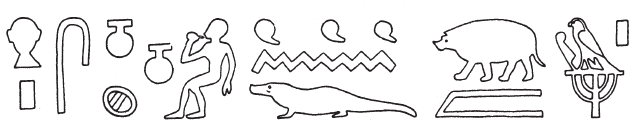 - The reading nṯr (crocodile = nty, pig = r(r)), was suggested by Meeks 2004, p. 65, §171, n. 3 (followed by Altmann-Wendling 2019, p. 631), and this would accord with Khnum’s epithet here (“Foremost of the Land of God”). Context would suggest a god’s name, such as Atum or Osiris, as in a similar passage in Esna 433, 1, but that would require emending the pig hieroglyph to a giraffe: Von Lieven 2000, p. 160, n. b.↩︎