Central Bay (424-430)
Esna 424
Location: Central Bay
Date: Titus and Domitian
Color photograph (partial view)
Bibliography: Von Lieven 2000, pp. 96-103; Altmann-Wendling 2019, pp. 624-625 (excerpt); see also Tempeltexte 2.0.
1nṯr wpš tȝ.wy
ḫʿỉ m n.t
psḏ m ḥr.t
[w]r(?) st.wt hrw
nmt(?)=f nḫt(.w)
sḫt-šzp=f
wbn m ḥr.t
nsw.t-bỉty
ẖnmw-Rʿ nb sḫ.t
Šw pw
ḏf(ḏ) n Rʿ
nṯr ʿȝ ʿnḫ
nb pr-nṯr
Ỉwn wr
nb nṯr.w rmṯ.w
ḏfn mnḫ
nb ḥw.t-ỉt
1 The god who lights up the lands,
who appears in the red crown32
who shines in heaven,
[gr]eat(?) of rays by day,
when his stride(?) is powerful.33
He who weaves his Radiance,
who rises in the sky.
The King of Upper and Lower Egypt,
Khnum-Re Lord of the Field,
that means Shu,
the iris of Re,
the great, living god,
Lord of Per-netjer,
great Iun-pillar,
lord of gods and humans,
beneficent ancestor,
Lord of the Temple of the Father.
sn.t=f m nb.t ȝḫ.t
r gs=f
m rn=s n Mnḥy.t
Nb.t-ww ḫr.tw r=s
Rnnwt.t ỉs dmḏ(.t) ḥnʿ=f
Šȝy Rnn.t
dmḏ(.w) m zp wʿ
nỉ ḥrỉ wʿ (r) snw=f
sfy šps ỉm
r-gs=w
ḥr wbn m ỉȝ.t tn
mn(.w) mỉ p.t
wȝḥ(.w) mỉ tȝ
nn ȝb rʿ-nb
His sister is the Excellent Lady
at his side,
in her name of Menhyt,
she is also called Nebtu,
aka Renenutet, united with him.
Shay and Renenet
are united as one,
one never leaves its second.34
The august child is there
at their side,
shining in this mound.
May they remain like the sky,
and endure like the earth,
without fail, every day.
2nsw.t-bỉty
tmȝ.t ḥr.t-tp
ḫp(r.t) m ḥȝ.t
N.t wr.t
mw.t-nṯr
nb(.t) tȝ-sn.t ḏr-ʿ
ms(.t)-ms.w
ỉt ỉt.w
mw.t mw.wt
bs(.t) m š(ȝ)ʿ
ḏr pȝwty.w
qrḥ.t ʿnḫ.t
dỉ(.t) tp=s m Nwn
ỉr(.t) ḥry.w
sḫp(r.t) ẖry.w
ṯȝy ỉr ṯȝy.w
ḥm.t ỉr(.t) ḥmw.wt
nbỉ.t ḥnw.t nb.wt
nb.t nỉw.wt
ḥnw.t spȝ.wt
smn(.w) ḫm.w ḥm=s
m nỉw.t nb(.t)
2 The King of Upper and Lower Egypt,
the mother uraeus,
who came about in the beginning,
Neith the great,
Mother of god,
Lady of Esna, since the beginning.
She who birthed the children,
father of fathers,
mother of mothers,
who emerged in the beginning,
since the time of the Primeval ones.
The living ancestor-serpent,
who poked her head out of Nun.
She who made what is above,
and created what is below;
man who made men,
woman who made women,
nbỉ.t-cow, mistress of cows.
Lady of cities,
Mistress of nomes,
the shrines of her Majesty
are established in every city.
gb.t
bẖ.n=s ỉʿḥ
pʿpʿ(.t) Ḫprỉ m wḏḥ
qmȝ(.t) psḏ.t m ỉb=s
msḫn.t nfr.t
ḫpr.t m šȝʿ
grg(.t) tȝ m pr.t=s
ỉỉ.n=s m wʿ(.t)
ḫpr.n=s m ḥḥ.w
ḥʿʿ.tw ḥr mnw pn nfr
ỉr.n nsw.t-bỉty
(ywtgrtr tts kysrs)|
ḏ.t
The celestial firmament,
as she birthed the lunar disk,35
she who bore Khepri as a youth,36
and created the Ennead through her mind.
The good birth-brick,
who came about in the beginning,
who populated the earth with her seed:
though she arrived as one,
she transformed into millions.
May she rejoice over this good monument
which the King of Upper and Lower Egypt made,
(Autokrator Titus Caesar)|
eternally!
3nfr.wy ḥr=ṯ
wbn=ṯ m pr=t
ʿq=ṯ ỉwn.t=t
m ȝw.t-ỉb
ʿpr(.w) m nfrw
nw sqȝ ḥm=t
snỉ=s r ȝḫ.t
ḥȝy.ty m-ḫnt=s
m ḥb ẖnm
dgȝ=ṯ mnw ʿȝ nfr
ỉr n=t zȝ-Rʿ
(twmtyns nty-ḫwỉ)|
3 How beautiful is your face!
As you shine in your temple,
and enter your colonnade hall
in happiness.
It is equipped with good things
for elevating your Majesty.
It resembles the Akhet,
and the two luminaries (Sun and moon)
are in it at the Union festival.37
May you behold the great, beautiful monument
which the Son of Re made for you,
(Domitian Augustus)|.
nbỉ.n=f ḫnty ʿȝ šps
m-rw.ty pr=f
wr.tw qȝ.tw
m ỉnr ḥḏ nfr rwḏ
pẖr(.w) m sš
nḫb(.w) ḥr rn wr
ʿpr(w) m ỉrw nb
nw snṯ pr=s
wḥʿ=s mn(.w)
mỉ p.t ẖr Rʿ
tȝ ẖr nty ỉm=f
ḥw.t-nṯr=s ḥnʿ.tw
m ỉḫt nb nfr
pr=s pr(.w)
m nfrw
s.t=s n rsy.t
zȝ-N.t
spȝ.t=s n mḥy.t
Mḥ-n.t
Zȝw=s pw m tȝ-šmʿ
ḥr ȝb ỉb=s m-ḫnt=s
rʿ-nb
ỉzwy ḫr=s
(ḫʿỉ) ḥr s.t-Ḥr
ḫnty ʿnḫ.w mỉ-Rʿ
He fashioned a great, august forecourt
before his(!) temple,
it is great and tall,
from enduring sandstone.
It is surrounded with writings,
inscribed in the great name (cartouche),
equipped with all rituals
of founding her temple,
its foundation endures,
like the sky bearing Re,
and the earth38 bearing its contents.
Her temple is supplied
with all good things,
her domain (pr) is overflowing (pr.w)
with goodness!
Her southern seat
is Esna (zȝ-N.t),
while her northern district
is Mehnet (Mḥ-N.t),39
it is her Sais in Upper Egypt,
as her heart desires to be in it,
every day.
The reward from her
is (appearing) upon the Throne of Horus,
foremost of the living, like Re.
Esna 425
- Location: Architrave C
- Date: Titus
-
Hieroglyphic Text
- Color photograph (far left)
- Bibliography: Von Lieven 2000, pp. 104-107; see also Tempeltexte 2.0.
- Parallels: Many of the phrases find corresponding expressions in the symmetric text Esna 427.
NB: This text and Esna 427 include multiple epithets identifying Neith with a cobra (Wadjyt) and vulture (Nekhbet). These clearly relate to the series of vulture- and cobra-headed vultures on the central panel of the ceiling: Esna 426.
psḏ ḥr(.t)-wȝḏ=s
m sḫ.t wʿb.t
m snn=s n ỉqḥ.t štȝ.t
spr=s tȝ-sn.t m ȝw(.t)-ỉb
wn=s ʿ.wy=s
ḥr nbỉ ḥw.t-ṯȝ.wy
ḥr mk(.t) nṯr.w m ḥw.t-N.t
sȝq=s dnḥ=s
ḥr ḫwỉ(.t) Rs(.t)-ḥw.wt=s
zȝ=s ḏd šps
m ʿḥ=f ṯn
ḫʿỉ=s m pr=f
psḏ=s m ḥr.t-tp=f
dỉ=s šsr=s
r wȝỉ ỉm=f
She She stop her Papyrus shines,40
from the pure field,
in her form of the mysterious vulture,
having reached Esna in happiness,
She opens her arms (i.e. wings):
protecting Temple of the Chicks,
guarding the gods in the Temple of Neith.
She joins together her wings,
while protecting Rs.t-ḥw.wt=s.41
She guards the August Djed-pillar
in this his palace;
she appears from his temple,
and she shines as the uraeus on his head,
and she sets her arrows
against whomever would plot against him.
ḫp(r)=s m ỉȝbt.t=f
mȝȝ=f m st.wt=s
n.t
bỉty(.t) n=f mḥw
ḫpr š-n-Ḥr m ḥtp
r s.t-rd.wy=f
rdỉ ỉw nb n kkw
ḏr-nty ntf nb ndb.t
ḥqȝ mnḫ m tȝ r-ḏr=f
ḥr ỉr(.t).n=f
dỉ ỉȝ.t-ṯȝ.wy m ršw
ḥr dỉ(.t) ḥfnw m rnp.wt
n zȝ-Rʿ
nb ḫʿ.w
(Wspsyns nty-ḫwỉ)|
mry ẖnmw-Rʿ nb sḫ.t
Šw zȝ-Rʿ
She transforms into his left-eye,
so he might see from her rays.
She of the red crown (n.t),
who rules Lower Egypt for him;42
the Lake of Horus has become peaceful,
and restored to its station.
Grant43 all that comes from the darkness!
For he is the Lord of the earth,
effective ruler in the entire land,
on account of what he accomplished!44
Place the Nome of the Chicks in jubilation,
by giving myriads of years
to the Son of Re,
Lord of Appearances,
(Vespasian Augustus)|45
beloved of Khnum-Re Lord of the Field,
Shu, Son of Re!
Esna 426
- Location: Central Bay
- Date: Titus and Domitian
-
Hieroglyphic Text
- Color photograph (middle)
- Bibliography: See Tempeltexte 2.0.
1Nḫb.t ḥḏ(.t) Nḫn
ȝw-ʿ dmȝ(.t) pḏ.t
nr.t wp(.t) Nw.t
dỉ=s ḥqȝ n Šw
n nsw.t-bỉty
(ywtkrtwr tts ksrs)|
2Nḫb.t ḥḏ(.t) Nḫn
ȝw-ʿ nb(.t) fʿg.t
pḥrr(.t) p.t
rʿ-nb
dỉ=s ʿḥʿ n Rʿ
n nsw.t-bỉty
(ywtkrtr tts ksrs)|
1 Nekhbet, white one of Nekhen,
long of arm, who seizes the bow,
vulture at the edge of the sky (Nut):
may she give the rule of Shu
to the King of Upper and Lower Egypt,
(Autokrator Titus Caesar)|.
2 Nekhbet, white one of Nekhen,
long of arm, Lady of F’g.t,
who runs across the sky,
every day:
may she give the lifetime of Re
to the King of Upper and Lower Egypt,
(Autokrator Titus Caesar)|.
3Wȝdy.t wȝḏ(.t) ʿnḫ
swḏȝ(.t) Ḥr m Ḫby.t
dỉ=s ns.t n Gbb
n zȝ-Rʿ
(twmtyns ḫwỉ)|
4Wȝḏy.t nb(.t) P Dp
šps.t wsr.t
ḥnw.t nṯr.w nb ḏ.t
dỉ=s ỉȝw.t n(.t) Ỉtm
n zȝ-Rʿ
(twmtyns ḫwỉ)|
3 Wadjyt who endows life,
who preserves Horus in Chemmis:
may she give the throne of Geb
to the Son of Re
(Domitian Augustus)|.
4 Wadjyt Lady of Pe and Dep,
august and mighty,
mistress of all the gods, forever:
may she give the office of Atum
to the Son of Re,
(Domitian Augustus)|.
5Nḫb.t wnm.t
wbn Rʿ ỉm=s m skt.t
dỉ=s ỉȝbt.t
r wbn ỉtn
n nsw.t-bỉty
(ywtkrtwr tts ksrs)|
6Nḫb.t ỉȝbt.t
ḥtp Rʿ ỉm=s m mʿnḏ.t
dỉ=s ỉmnt.t
r ḥtp=f
n nsw.t-bỉty
(ywtkrtr tts ksrs)|
5 Nekhbet the right eye,
Re rises from her in the day-bark:
may she give the East
as far as the sunrise,
to the King of Upper and Lower Egypt,
(Autokrator Titus Caesar)|.
6 Nekhbet the left eye,
Re sets in her in the night-bark:
may she give the West
as far as his setting,
to the King of Upper and Lower Egypt,
(Autokrator Titus Caesar)|.
To be continued…
Esna 427
- Location: Central Bay
- Date: Titus
-
Hieroglyphic Text
- Color photograph (far right)
- Bibliography: Von Lieven 2000, pp. 108-111; see also Tempeltexte 2.0.
- Parallels: Many of the phrases find corresponding expressions in the symmetric text Esna 425.
wbn štȝ.t m [Nḫn…]
m sḏḏ=s n ḥwr.t wr.t
ẖnbb.n=s Ỉwny.t m nḏm-ỉb
pgȝ=s dmȝ.ty=s
ḥr ḫw(.t) ỉȝ.t-ṯȝ.wy
ḥr mk(.t) sḫm.w m ḥw.t-ẖnmw
ẖnm=s Nḥp
m ḥw.t-nṯr=f tn
mk=s ḏ.t=f
swḏȝ=s ỉwf=f
ḫw=s ḥm=f m ḥḏ=f
dỉ=s r-ḥȝ
wn=s m mḥn.t=f
wbd.n=s ḫfty=f m nbỉ.t=s
When the mysterious vulture rises in Nekhen46[…]
in her form of the great bird of prey,
having entered Iunyt in joy,
She spreads her wings
guarding Nome of the Chicks,
protecting the statues of Temple of Khnum.
She unites with the Potter
in this his temple,
she protects his body,
she keeps his flesh healthy,
and she guards his Majesty in his shrine.
When she goes outside,
she exists as his coiled uraeus,
burning his enemy with her flame.47
ḫp(r)=s m wnm.t=f
ʿnḫ=f ỉm=s
ḥḏ.t n nsw.t
tp dwȝw
ḫrp.tw n=f gȝ.w(t)
nw Ḫnty-ḥn-nfr
rdỉ pr nb m ṯȝw
mỉ-nty ntf nb ỉḫt-mn
ỉty n ỉfdw Nw.t
hr ḥr ỉr(.t).n=f
dỉ tȝ-sn.t m ḥb
ḥr dỉ(.t) ḥb-sd.w ʿšȝ
n nsw.t-bỉty
nb tȝ.wy
(ȝwtkrtwr tỉtỉs ksrs)|
mry ẖnmw-Rʿ nb tȝ-sn.t
Ṯnn ỉt nṯr.w
She transforms into his right eye,
through which he lives:
the white crown of the nsw.t-king,
each morning,
when tribute is brought to him
from Khenty-hen-nefer (Nubia).
Grant all that comes from the wind!48
For he is the Lord of the world,
sovereign of the four corners of the sky.
Be pleased with what he accomplished!
Place Esna in festival,
by giving numerous Sed-festivals
to the King of Upper and Lower Egypt,
Lord of the Two Lands,
(Autokrator Titus Caesar)|
beloved of Khnum-Re Lord of Esna,
Tatenen father of the gods!
Esna 428
- Location: Bay Centrale
- Date: Domitian
-
Hieroglyphic Text
- Bibliography: None
Cartouches of Domitian with Khnum-Re Lord of Esna.
Esna 429
- Location: Bay Centrale
- Date: Titus
-
Hieroglyphic Text
- Bibliography: None
Cartouches of Titus with Khnum-Re Lord of Esna. For the reading of the cartouches, see Sauneron 1968, p. 392.
Esna 430
- Location: Central Bay
- Date: Titus or Domitian
- Hieroglyphic Text
Labels to the giant winged sundisk
anb Msn
nṯr ʿȝ nb p.t
zȝb-šw.ty
pr m ȝḫ.t
ḫnty ỉtr.ty mḥw
dỉ(.w) ʿnḫ
Lord of Mesen,
great god, lord of heaven,
dappled of plumage,
who emerges from the Akhet,
foremost of the dual chapels of Lower Egypt,
given life.
Bḥdty
nṯr ʿȝ nb p.t
zȝb-šw.ty
pr m ȝḫ.t
ḫnty ỉtr.ty šmʿ
dỉ(.w) ʿnḫ
He of Behdet,
great god, lord of heaven,
dappled of plumage,
who emerges from the Akhet,
foremost of the dual chapels of Upper Egypt,
given life.
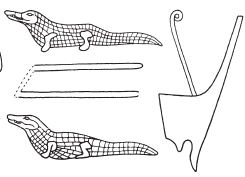 - Von Lieven 2000, pp. 96-97, tentatively read the second crocodile as ḫnt, “die Spitze”, but that would not explain the red crown; Klotz 2014, p. 58, alternately read the sign along with the crown as ỉtn, “sun disk”, but the lack of determinative is problematic. Instead, the symmetric architrave inscription begins with a nearly identical phrase: “he who appears in the white crown”, Esna 431, 1. Since the present text is on the northern side of the Central Bay, the simplest solution is to read n.t, “red crown”, here derived from nty, “crocodile” (Wb. II, 355, 12).↩︎
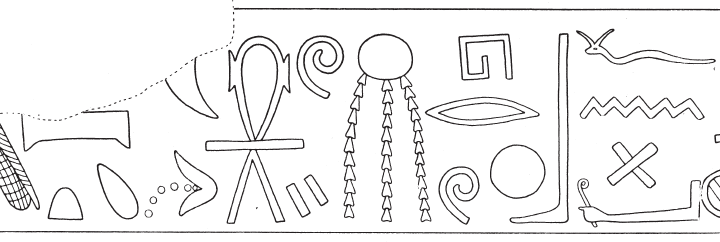 - This text is quite difficult. Sauneron understood the sign above the spitting mouth to be ḏr, but then the translation is difficult. The following composite sign Von Lieven 2000, p. 96, transcribed sḥḏ(?), “hell werden,” but since it combines zȝ + tȝ (recalling the cheer zȝ-tȝ, Wb. III, 416), the group more likely writes st.wt, “rays.” Finally, the leg is quite confusing. Here I very tentatively assume it has interchanged with the bull’s leg which typically writes nmt, “steps; course”, here alluding to the powerful and wide-ranging rays of the sun.↩︎
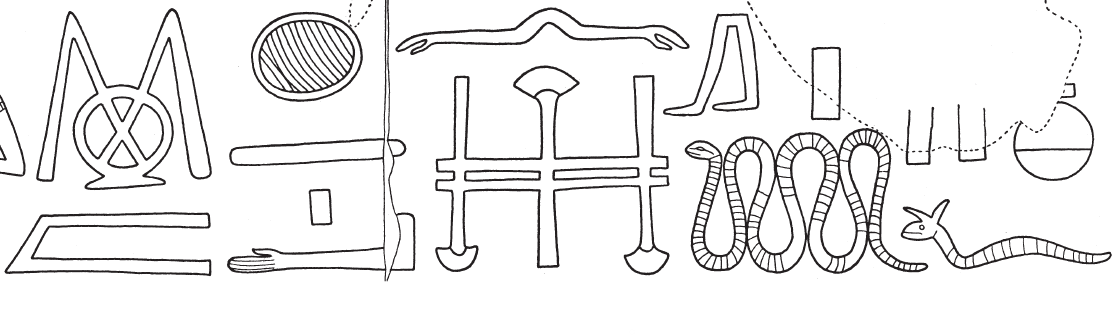 - Von Lieven 2000, pp. 96-97 read this phrase slightly differently (“sind vereint in seiner Faust (dmḏ m ḫfʿ<=f>), sie ist nicht fern von ihm (nỉ ḥrỉ=s n=f)”). The expected harpoon for the first wʿ has been simplified to a horizontal stroke, as again later on line 2 (ỉỉ.n=s m wʿ). Here the single coiled serpent, appropriate for Shay and Renenet, or the primeval Irita (Khnum) and his serpent partner (Menhyt), writes wʿ, “one”, a value used elsewhere at Esna: Klotz 2012, p. 173; see also Esna 424, 2; Esna II, 63, 3; 64, 2; 104, 4; Esna III, 200, 8; Esna VI, 507; Esna VII, 549. In several of those texts, Khnun and Menhyt are described as primeval, intertwined serpents, difficult to distinguish.↩︎
Despite the close parallel in Esna II, 24, 13 which uses the term ỉtn, “disk” (noted by Von Lieven 2000, p. 96, n. a), the photograph clearly shows this sign is a full moon with lunar crescent, tilted on its side.↩︎
The same epithet in Esna II, 26, 17; 91, 16-17.↩︎
Assuming the first ḥb-sign is to be read as an ideogram, while the second is a determinative. For alternative suggestions, see Altmann-Wendling 2019, p. 624. n. 161. It is clear nonetheless that the festival alludes to the joint appearance (“union”) of the sun and moon.↩︎
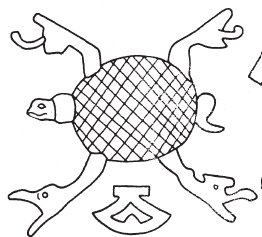 - In this remarkable hieroglyph, the earth is conceived as a cosmic tortoise with each leg, wearing red crowns just like Neith, representing the cardinal directions: Meeks 2004, p. 106. The same image appears in Esna 451. Compare a detailed, color photograph.↩︎
For the interpretation of this passage, see Klotz 2014, pp. 41-42. There is also a phonetic pun here: Neith’s ancient chapels in Sais were the Rs-n.t and Mḥ-n.t shrines. In this passage, the southern (rsy.t) seat, “Esna”, is spelled without the initial tȝ-element, emphasizing the similar sound to Rs-n.t (e.g. “Resna”). Compare especially Esna II, 63, 1.↩︎
This is an epithet of the serpentine Wadjet nearby in Esna 426, 16; see also LGG V, 437c-438a. It is also a good description of the cobra on a papyrus which appears in Esna 401, C, top right corner.↩︎
For Neith as a vulture protecting Re and other divinities within Esna, see especially Esna II, 160, 2-3. It appears something is missing after the verb ḫwỉ. Rs.t-ḥw.wt=s is an epithet of Neith, so presumably she should be the one protecting other divinities.↩︎
Following Kurth 2004, p. 27, who noted similarities with the symmetric text Esna 427, which links Nekhbet to the white crown.↩︎
 - Von Lieven 2000, pp. 104-105, read: šnʿ ỉyỉ nb m kkw, “abgewehrt wird jeder, der in der Dunkelheit kommt.” However, the symmetric text (Esna 427) has a similar formulation, where the verb must be rdỉ, “to give”:
 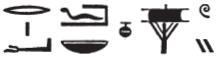 . This could just be an active participle, further modifying the epithets of Neith. But since both texts add a persuasive argument (mỉ-nty ntf…), this might instead be the non-suppletive imperative form, attested in Old Egyptian and later in archaizing texts.↩︎
The emperor Titus incorporated the name of his father, Vespasian, in his royal titulary. That this particular inscription dates to Titus is clear from the symmetric text (Esna 427), and nearby cartouches on the central row including the element “Titus”: Esna 426, Esna 429. See Sauneron 1968, p. 392. Nonetheless, nearby Esna 431 belongs to Vespasian, and he also appears on the column capitals: Esna 457, Esna 458, Esna 459. So work on the central row began under Vespasian, but was completed by his Flavian successors Titus and Domitian.↩︎
The emperor Titus incorporated the name of his father, Vespasian, in his royal titulary. That this particular inscription dates to Titus is clear from the symmetric text (Esna 427), and nearby cartouches on the central row including the element “Titus”: Esna 426, Esna 429. See Sauneron 1968, p. 392. Nonetheless, nearby Esna 431 belongs to Vespasian, and he also appears on the column capitals: Esna 457, Esna 458, Esna 459. So work on the central row began under Vespasian, but was completed by his Flavian successors Titus and Domitian.↩︎
This reading would seem to fit the shape in the color photograph, and would be appropriate for Nekhbet.↩︎
Here the vulture transforms into a uraeus serpent, a role typically performed by Menhyt. This change is appropriate for the vultures in Esna 426 whose heads are alternately avian and serpentine.↩︎
For the translation of rdỉ and the following dỉ as imperatives, see the similar phraseology in Esna 425.↩︎