Column Summits (455-472)
The elaborate column capitals (described and translated in Esna II and Esna III) are surmounted by stone cubes, which support the architraves. Typically each face is decorated with royal cartouches, and the king is beloved of various local divinities.
The columns from the facade (455-460) are fairly simple, and will be briefly described, not translated. However the inscriptions on the columns of the interior (461-472) feature complex visual puns, and those will translated with commentary below.
Esna 455
- Location: Top of column A
- Date: Vespasian
- Hieroglyphic Text
Vespasian is beloved of:
South Isis
East Shemanefer
North Osiris
West Khnum
Esna 456
- Location: Top of column B
- Date: Vespasian
- Hieroglyphic Text
Vespasian is beloved of:
South Nebtu
East Menehwy
North Neith
West Menehwy
Esna 457
- Location: Top of column C
- Date: Vespasian
- Hieroglyphic Text
Vespasian is beloved of:
South Shemanefer
East Neith
North Menhyt
West Menehwy
Esna 458
- Location: Top of column D
- Date: Vespasian
- Hieroglyphic Text
Vespasian is beloved of:
South Nebtu
East Khnum
North Menhyt
West Nebtu
Esna 459
- Location: Top of column E
- Date: Vespasian
- Hieroglyphic Text
Vespasian is beloved of:
South Heka
East Menhyt
North Neith
West Menehwy
Esna 460
- Location: Top of column F
- Date: Titus
- Hieroglyphic Text
Vespasian is beloved of:
South Menhyt
East Khnum-Re
North Neith
West Menehwy
Esna 461
- Location: Top of column 1
- Date: Trajan
-
Hieroglyphic Text
- Bibliography: el-Sayed 1982, II, p. 658, Doc. 1082b; see also Tempeltexte 2.0
NB: As is typical for the summits of columns, the following texts employ many sportive writings of local divinities and epithets, relying heavily on anthropomorphic ideograms. For this reason, the full texts will be reproduced here, rather than multiple images in the text notes.
The text abbreviations (S,E,N,O) in the following columns refer to the cardinal directions in Sauneron’s French edition. They correspond to: S(outh), E(ast), N(orth), O(uest) = W(est). The French abbreviations are kept here to assist the reader comparing the hieroglyphic texts.
Sauneron published the inscriptions clockwise and counter-clockwise, but this usually splits up the divine epithets from the sacred names. Accordingly, I have translated the texts in a different sequence. Just as on the column bases, one text (the divine epithets) proceeds from a starting point in one direction, then the second text (benefits for the king) proceed from the same starting point in the opposite direction.
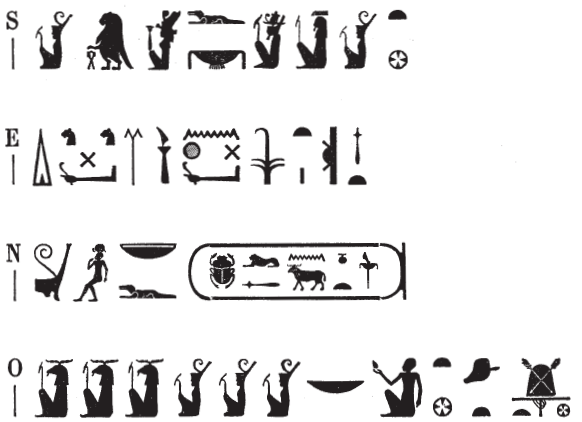
SN.t wr.t
mw.t-nṯr nb(.t) tȝ-sn.t
O(ỉt)-ỉt.w
(mw.t)-mw.wt
nb.t zȝw
ḫnt(.t) N.t
Edỉ(.t) pḥty
m qn nḫt
nswy.t ʿȝ.t
Nn zȝ-Rʿ
nb ḫʿ.w
(trʿns nt-ḫwỉ)|
S Neith the great,
Mother of god, Lady of Esna,
O (Father) of Fathers,
(Mother) of Mothers,91
Lady of Sais,
foremost of the Neith nome;
E (she who) gives strength,
as a mighty victory,
and a great kingship
N to the Son of Re,
Lord of Appearances,
(Trajan Augustus)|
Esna 462
- Location: Top of column 2
- Date: Trajan
-
Hieroglyphic Text
- Bibliography: See Tempeltexte 2.0.
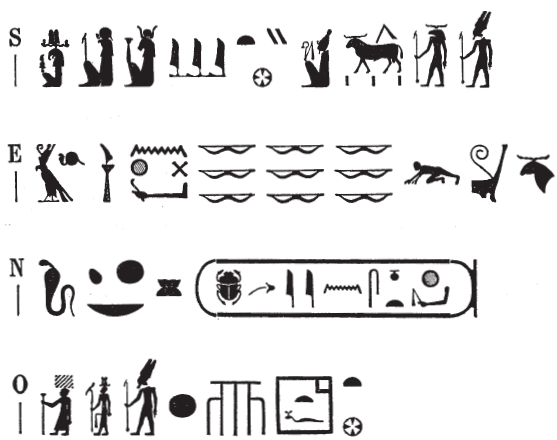
Sẖnmw-Rʿ nb sḫ.t
nsw.t nṯr.w
nṯr ʿȝ Oʿnḫ
ḫnty ḥw.t-ỉt
Erdỉ(?) qn nḫt
pḏ.t 9 ḫb(.w)
n šfy.t Nn zȝ-Rʿ
nb ḫʿ(.w)
(tryns nty-ḫwỉ)|
S Khnum-Re Lord of the Field,
King of the Gods,
great living O god
foremost of Temple of the Father.92
E who gives(?)93 might and victory,
the Nine Bows falling down
to the prestige N of the Son of Re,
Lord of Appearance(s),
(Trajan Augustus)|
Esna 463
- Location: Top of column 3
- Date: Unknown
-
Hieroglyphic Text
- Bibliography: el-Sayed 1982, p. 658, Doc. 1082c; see also Tempeltexte 2.0.
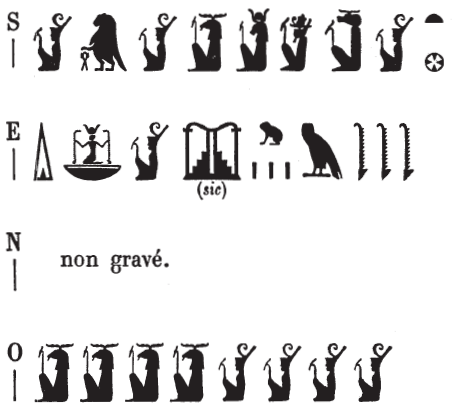
SN.t wr.t
mw.t-nṯr
nb.t tȝ-sn.t
Oỉt-ỉt.w
mw.t mw.wt
Edỉ(.t) ḥḥ n ḥb.w-sd.w
ḥfn.w m rnp.wt
S Neith the great,
Mother of God,
Lady of Esna,
O Father of fathers,
Mother of mothers,
E who gives millions of Sed-festivals
and myriads of years.
Esna 464
- Location: Top of column 4
- Date: Titus
-
Hieroglyphic Text
- Bibliography: See Tempeltexte 2.0.
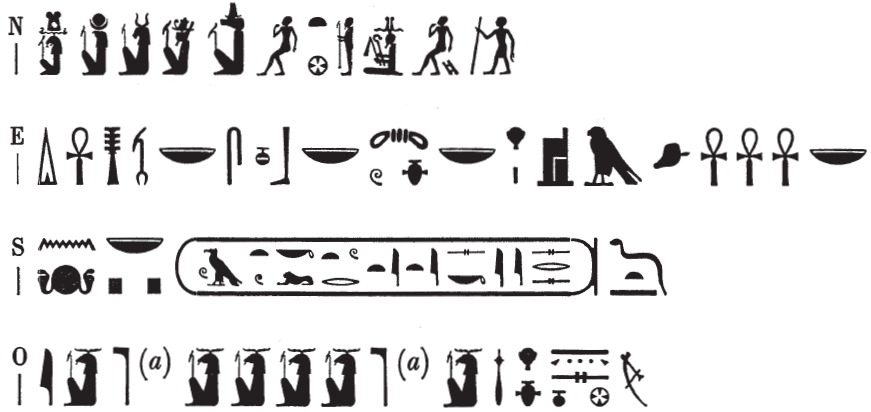
Nmry ẖnmw-Rʿ nb tȝ-sn.t
Ptḥ-Ṯnn
Nwn wr
Oỉt nṯr.w
nṯr ʿȝ ḥry-ỉb tȝ-sn.t
Edỉ ʿnḫ-ḏd-wȝs nb
snb nb ȝw.t-ỉbt nb
ḥr s.t-Ḥr
ḫnty ʿnḫ.w nb
Sn nsw.t-bỉty
nb tȝ.wy
(ȝwtwkrtwr tỉtỉs kysrs)|
ʿnḫ(.w) ḏ.t
N Beloved of Khnum-Re Lord of Esna,
Ptah-Tatenen,
Nun the great,
O Father of the gods,
Great god within Esna.
E He who gives all ʿnḫ-ḏd-wʿs,
all health, all happiness
upon the throne of Horus,
foremost of all the living,
S for the King of Upper and Lower Egypt,
Lord of the Two Lands,
(Autokrator Titus Caesar)|
may he live forever!
Esna 465
- Location: Top of column 5
- Date: Trajan
-
Hieroglyphic Text
- Bibliography: el-Sayed 1982, p. 658, Doc. 1082d; see also Tempeltexte 2.0.
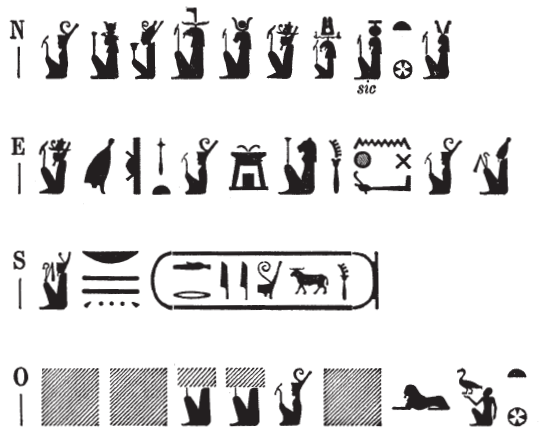
NN.t wr.t
mw.t-nṯr
nb.t tȝ-sn.t
štȝ.t O[wr.t]
[…] nb(.t) Zȝw
Edỉ(.t) nswy.t ʿȝ.t
m ȝw.t-ỉb
pḥty qn nḫt
n nsw.t Sbỉty
nb tȝ.wy
(dryns (nty)-ḫwỉ)|
N Neith the great,
Mother of god,
Lady of Esna,
[great] O mysterious one
[…] Lady of Sais.
E She who gives94 a great kingship
in happiness,
strength, victory, and might95
to the King of Upper S and Lower Egypt,
Lord of the Two Lands,
(Trajan Augustus)|
Esna 466
- Location: Top of column 6
- Date: Uncertain, but the other texts on column 6 are all from the reign of Trajan
-
Hieroglyphic Text
- Bibliography: See Tempeltexte 2.0.
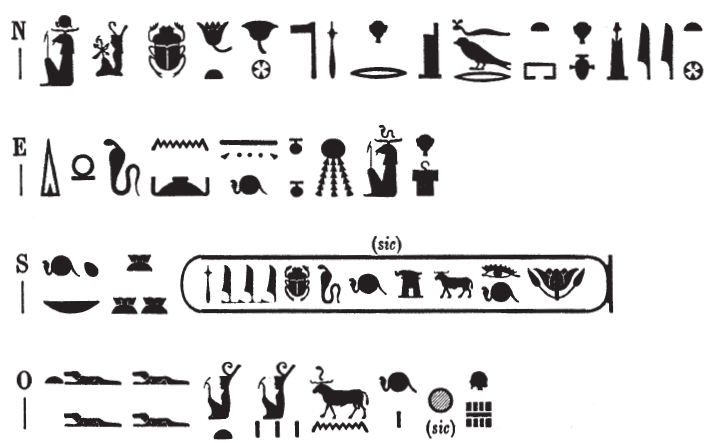
Nẖnmw-Rʿ nb tȝ-sn.t
nṯr ʿȝ ḥry s.t=f wr.t
ḥry-ỉb Ỉwny.t
Oỉt-ỉt.w
mw.t-mw.wt
wbn zp tpy
Edỉ(=ỉ) šnw nb n ỉtn
wbn=ỉ ḥr=s
S(n) zȝ-Rʿ
nb ḫʿ.w
(ȝwtkr(twr) ksʿrs)|
N Khnum-Re Lord of Esna,
great god upon his great throne
within Iunyt;
O Father of fathers,
Mother of mothers,
who arose (in) the first moment.
E (I) give the whole circuit of the sundisk,
over which I shine,
S (to) the Son of Re,
Lord of Appearances
(Autokra(tor) Caesar)|
Esna 467
- Location: Top of column 9
- Date: Domitian
-
Hieroglyphic Text
- Bibliography: See Tempeltexte 2.0.
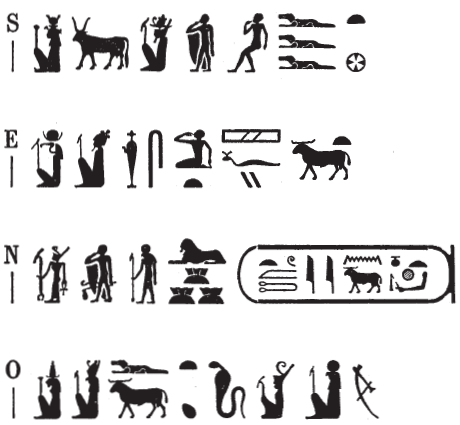
Smry Nb.t-ww nb.t tȝ-sn.t
Omḥn.t nt Rʿ
Edỉ(.t) wsr ḥz.wt šfy.t
Nn zȝ-Rʿ
nb ḫʿ.w
(twmṯyns nty-ḫwỉ)|
S Beloved of Nebtu, Lady of Esna,
O the coiled uraeus of Re,96
E who gives might, praise, and prestige
N to the Son of Re,
Lord of Appearances,
(Domitian Augustus)|
Esna 468
- Location: Top of column 10
- Date: Vespasian
-
Hieroglyphic Text
- Bibliography: See Tempeltexte 2.0.
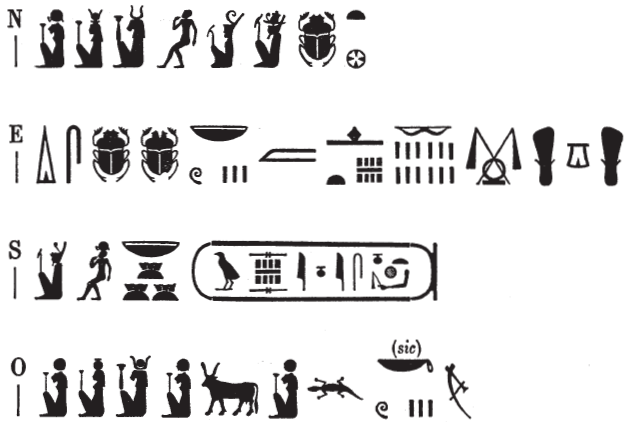
Nmry Mnḥy.t-nb.t-ww nb.t ḫnt-tȝ
OBȝst.t nb.t wpy
nb.t tḫ
ʿšȝ ḥb.w
Edỉ=s tȝ.w nb.w m ḥtp
pḏ.t 9.t dmḏ(.w) ẖr ṯb.ty
Sn zȝ Rʿ
nb ḫʿ.w
(wspsyns nty-ḫwỉ)|
N Beloved of Menhyt-Nebtu Lady of Khent-ta,
O Bastet(?) Lady of wpy-festival,
beloved of inebriation(?),97
numerous of festivals.
E May she give all lands in peace,
and the Nine Bows bound under the sandals
S of the Son of Re,
Lord of Appearances,
(Vespasian Augustus)|
Esna 469
- Location: Top of column 11
- Date: Trajan
-
Hieroglyphic Text
- Bibliography: Leitz 2001, p. 271 (excerpt); see also Tempeltexte 2.0.
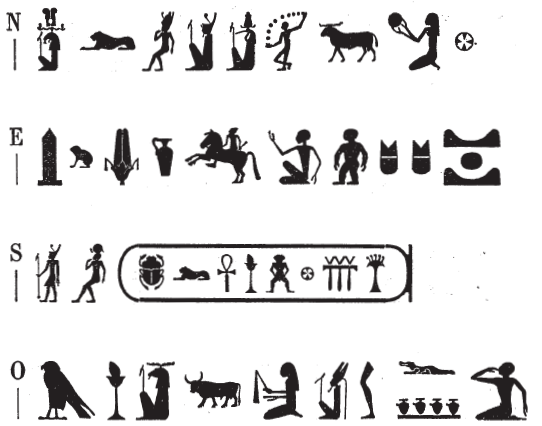
Nẖnmw-Rʿ nb tȝ-sn.t
Oḥry nḥp
nb qd
ỉqd r mr=f
Edỉ(.w) ḥqȝ nfr
ḥzy(?) qn
n/m ḥn.ty nḥḥ
Sn zȝ-Rʿ
(trʿns nty-ḫwỉ)|
N Khnum-Re Lord of Esna,98
O Chief of the Potter’s Wheel,
Lord of building,
who fashions (on the wheel) as he desires,99
E who gives a good rule,100
praise(?) and victory101
for the limits of eternity,
S to the Son of Re,
(Trajan Augustus)|102
Esna 470
- Location: Top of column 15
- Date: Uncertain
-
Hieroglyphic Text
- Bibliography: See Tempeltexte 2.0.
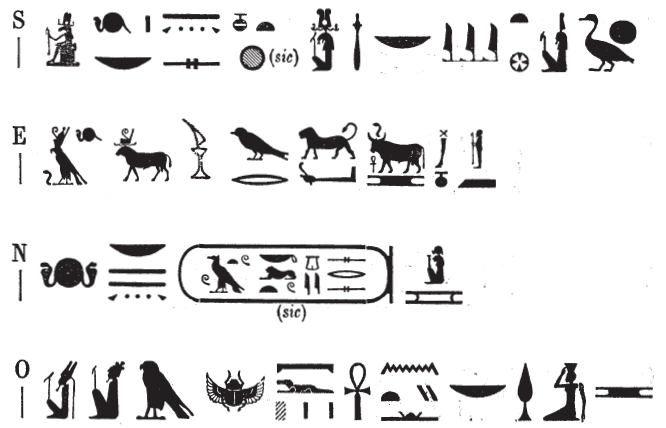
Smry ẖnmw-Rʿ nb tȝ-sn.t
nṯr ʿȝ nb sḫ.t
Šw zȝ-Rʿ
Onṯr ʿȝ ʿnḫ
ḥry nṯr.w
ʿnḫ nty nb ỉm=f
EḤr nb qn
wr pḥty
mry Ḥp wḥm n Ptḥ
Nnsw.t-bỉty
nb tȝ.wy
(ȝwtwkrtw(r) gysrs)|
mry Mnḥy.t
S Beloved of Khnum-Re Lord of Esna,
Great god, Lord of the Field,
Shu, son of Re,
O Amun, great living god(?),103
chief of the gods,
all that exists lives from him.
E The Horus, Lord of might,
great of strength,
beloved of Apis, herald of Ptah.
N King of Upper and Lower Egypt,
Lord of the Two Lands,
(Autokrato(r) Caesar)|
beloved of Menhyt.
Esna 471
- Location: Top of column 16
- Date: Uncertain, but the rest of column 16 dates to the reign of Domitian
-
Hieroglyphic Text
- Bibliography: See Tempeltexte 2.0.
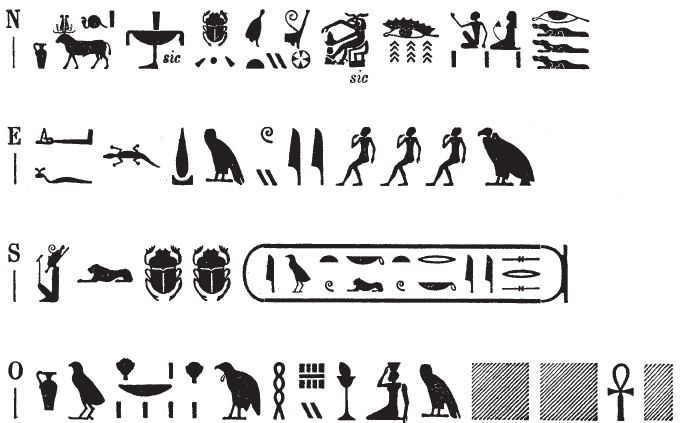
Nẖnmw-Rʿ nb tȝ-sn.t
qdỉ rmṯ.w
ỉr nṯr.w
Oẖnm ḥr.w-nb.w ḥr nḥp=f
m [sḫm/rn=f n ḫnty Pr-]ʿnḫ
Edỉ=f ʿšȝ ḏȝm.w
n Snsw.t bỉty
nb tȝ.wy
(ỉwtwkrtwr kysrs)|
N Khnum-Re Lord of Esna,
who fashioned humans,
and made the gods,
O who forms everybody on his wheel,
in [his form/name of Foremost of Per]-ankh.104
May he give numerous generations
to S the King of Upper and Lower Egypt,
Lord of the Two Lands,
(Autokrator Caesar)|.
Esna 472
- Location: Top of column 17
- Date: Uncertain, but the rest of column 17 dates to the reign of Trajan
-
Hieroglyphic Text
- Bibliography: See Tempeltexte 2.0.
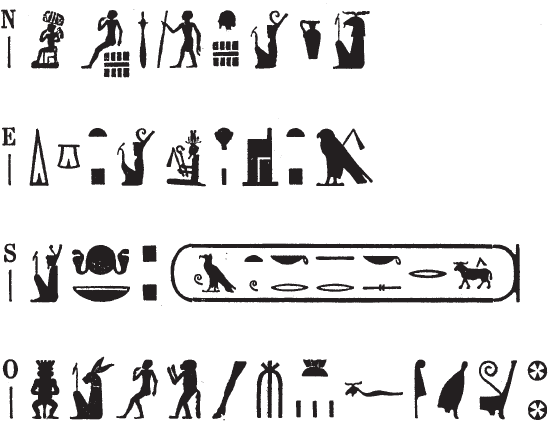
NḤkȝ p(ȝ)-ẖrd
ʿȝ wr tpy n ẖnmw
Obs štȝ
ḫy nfr wḥm-msḫʿ.w=f
m šmʿ-mḥw
Edỉ ns.t n.t Ṯnn
ḥr s.t-Ḫr
Sn nsw.t-bỉty
nb tȝ.wy
(ȝwtwkrtr ksrs)|
N Heka the Child,
eldest, first-born of Khnum,
O mysterious form,
good child,
who repeats his luminous births
in Upper and Lower Egypt.
E He who gives the throne of Tatenen,
together with the throne of Horus
S to the King of Upper and Lower Egypt,
Lord of the Two Lands
(Autokrator Caesar)|
Following the reading suggested by el-Sayed 1982, II, p. 658, n. 3. Compare a clearer example of this epithet with four Khnums and Neiths in Esna 463, O, and similarly Esna 466, O.↩︎
The understanding of the epithets here are based on Esna III, 350, 8-9 = Esna VI, 475, 6-7, where most of the same phrases occur, albeit in slightly different order. Presumably the ideogram of Amun writes both aA, “great” and nfr, “good”; the former value is well-attested elsewhere: Klotz 2015, p. 67, No. 14.↩︎
It is unclear how to read the Horus figure at the beginning of this line. It appears in the same position in Esna 470, E, as well as at the beginning of two architrave texts: Esna 424, 1; Esna 431, 1. In the later two cases, it appears to write wnn, but could also just be an emblematic sign to begin the text. In all the surrounding texts from the column summits, one expects a form of the verb rdỉ, “to give” here.↩︎
Remarkably the ideogram of Geb, identifiable by his typical crown, who writes tȝ in “Esna” in the epithet of Neith (above N), here represents the verb dỉ, “to give”, a phonetic variant of tȝ: see already Kurth 2007, p. 140, No. 67.↩︎
Here Neith represents the uniliteral m (< N.t, or from mw.t-(nṯr), “mother of god”), and the temple-shaped pectoral writes ȝw.t-ỉb, the usual name for that amulet. Presumably the lioness-goddess represents pḥty, “strength”, usually spelled with the hieroglyph of a lion’s rump, but also written with a standing lion: cf. Philä II, 401, 2 and 8; Klotz 2015, pp. 93-94, n. o. For the three types of strength grouped together, see also Esna 461, E.↩︎
This epithet was identified already in LGG III, 390c. The atef-crown is a distinguishing feature of Mehit: see Edfou IX, Pls. 30a-b; Spencer 1999, pp. 64, 68, 71; and this temple relief from Sebennytos. Horus writes ḥ(r), the crocodile writes nt (Wb. II, 355, 12) and the ram writes t < ṯȝy, “male.”↩︎
The interpretation of the epithets remain highly speculative. There are three ideograms of Menhyt, and at least two signs (cow goddess and cow) which could write nb.t, “lady.” Nonetheless, the most common epithets preceding ʿšȝ-ḥb.w for both Menhyt and Nebtu are nb.t-wpy and nb.t-tḫ. Perhaps for the first, the figure of Nut writes nb.t, while the seated cow writes wp because of her horns. In the second example, the final Menhyt figure could be an ideogram for tḫ, “inebriation.”↩︎
This name involves a certain amount of acrophony. “Re” is spelled r(w) (< “lion”) + ʿ (< “child”). In the toponym, tȝ < “Thoth” (see Esna 467, E), s (< sṯỉ), n (< nṯr, “god”), t (< dḫn, “to set a rhythm”). The final sign might also write n < nhm, “to rejoice; make music”, but then there would be two n’s.↩︎
Leitz 2001, p. 271, No. 41, read this passage quite differently: pȝ nḥp (“the potter”), kȝ šps (“august bull”), Ỉmn-rn=f, “hidden of name,” ther latter via acrophony (r < rd “foot”, n < nty, “crocodile”, f < fdw, “four (jugs)”). While the falcon can write pȝ, a far more common epithet of Khnum at Esna is “Chief of the Potter’s wheel.” The epithet “august bull” is not otherwise attested in the temple (LGG VII, 272c, cites two New Kingdom examples).
The present interpretation is based on the phrases which most often occur alongside “Chief of the Potter’s wheel”: nb qd (bull = nb, mummy = qd; cf. Wb. V, 75), and ỉqd r-mr=f. For the latter, Amun = ỉ (cf. Esna III, 379, 24: ỉḏr.w, “limits”), the leg = qd (< qdỉ, “to move around”, determined with this sign: Wb V, 78, 1), crocodile = r (Leitz 2001, p. 271), and the four milk jugs = mr (< “milk jug”, Wb. II, 105, 18), while the man writes the suffix-pronoun (=f), via substitution of similar signs.↩︎The obelisk = dỉ (< tḫn, “obelisk”); frog = ḥqȝ (< Heqet, the frog-goddess); nfr < Nefertem.↩︎
These signs are somewhat uncertain. Tentatively suggesting the first vessel is a variant of the ḥz-ewer. The man on a horse is a relatively rare sign, which elsewhere writes qn, “victory; might”: Kurth 2007, p. 197, No. 8; Guermeur 2012.↩︎
Several signs in this cartouche derive their uniliteral values from acrophony: t < tȝ (scarab); r < rw, “lion”; ʿ < ʿnḫ, “life”; n < nḥp, “potter’s wheel”, s < sṯỉ, “to ejaculate” (frontal man); n < nỉw.t, “city”; ty < ṯḥn, “to scintillate”; ḫwỉ < “fan.”↩︎
The interpretation of the first signs are not entirely clear. Similar epithets of Khnum Lord of the Field occur in Esna III, 328, A: “Great living god, chief of all the gods.” Presumably the falcon writes nṯr, Osiris writes ʿȝ, and the flying scarab writes ʿnḫ, as elswhere, e.g. Esna III, 298, A and B; 377, 6.↩︎
Restored after Esna II, 15, 12-13; 17, 40; with a slight variant in Esna III, 249, 1, §16. See Fernández Pichel 2018, pp. 66-67.↩︎